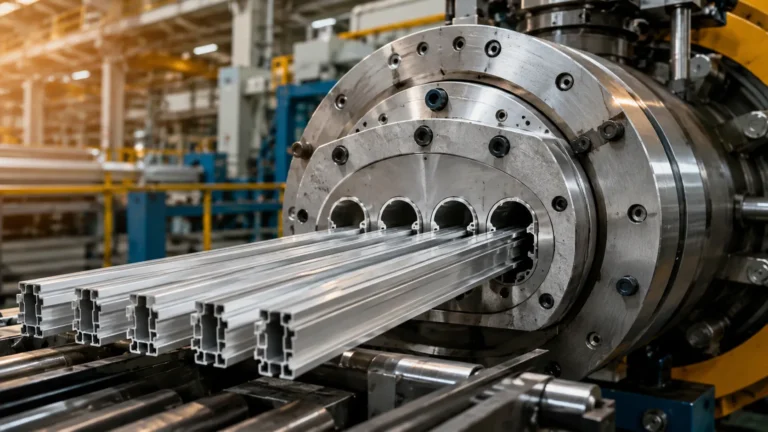
Aluminum extrusion dies operate under demanding conditions. High temperatures, substantial pressure, repeated production cycles, and continuous contact with hot aluminum gradually affect the working surfaces of even well-engineered tooling.
For extrusion manufacturers in the UAE, where productivity, profile consistency, and equipment utilization are critical, extending die life is an important part of maintaining an efficient operation. One of the most established methods used to improve the wear resistance of extrusion dies is nitriding.
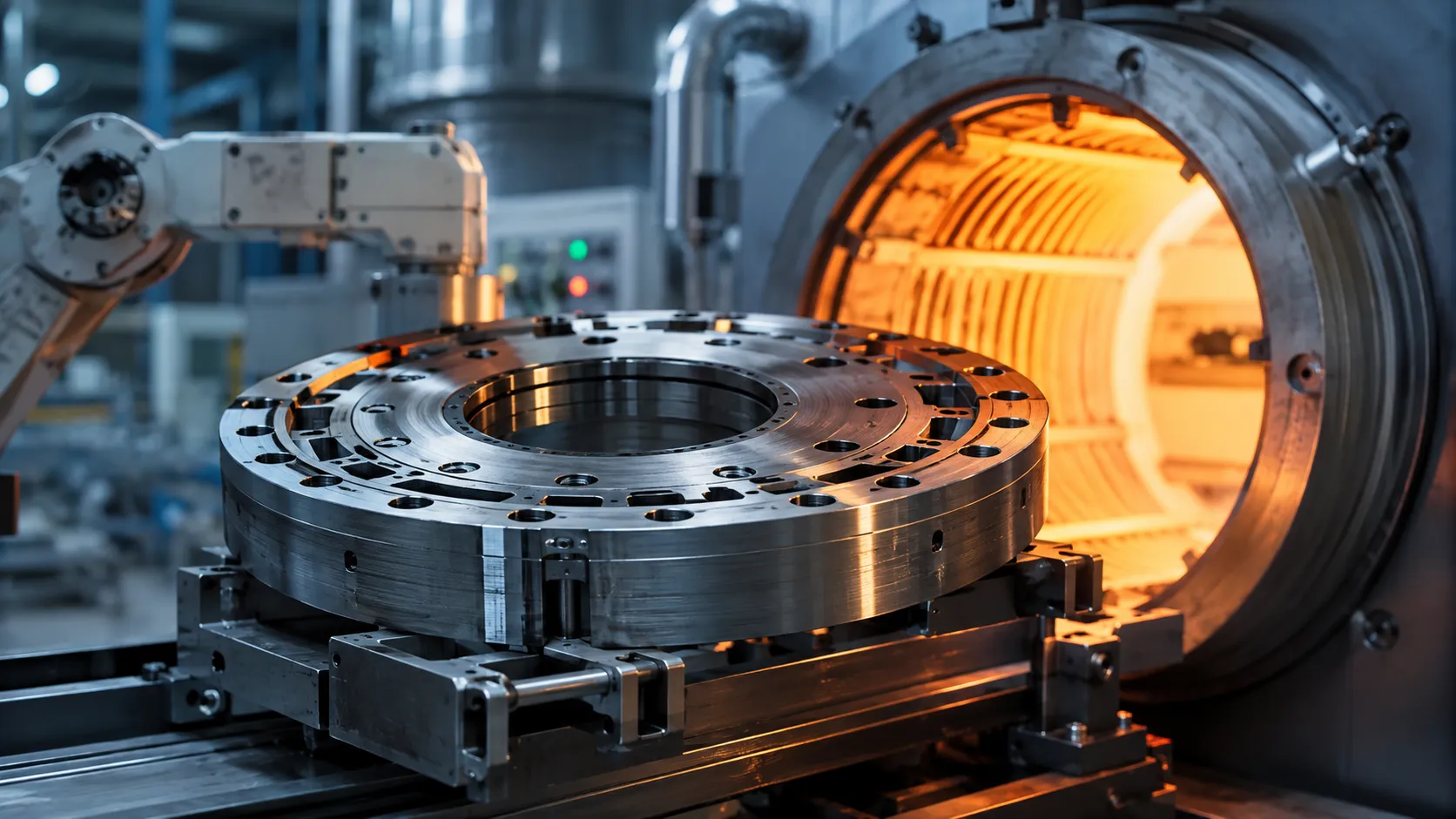
Nitriding is a surface-hardening process that introduces nitrogen into the surface of the tool steel. Rather than changing the entire structure of the die, the treatment strengthens the working surface where wear is most likely to occur. Research and industry guidance identify nitriding as a widely used treatment for aluminum extrusion dies because of its ability to improve surface hardness and wear resistance.
Protecting Critical Die Surfaces
During extrusion, aluminum moves through the die under significant pressure and temperature. The bearing areas that control the final profile dimensions experience repeated friction and thermal loading.
Over time, this can cause wear that gradually alters the geometry of the die. Even relatively small changes can affect profile dimensions, surface quality, and extrusion consistency.
A properly nitrided surface provides an additional layer of protection against this wear. By increasing surface hardness while maintaining the underlying toughness of the tool steel, nitriding helps the die withstand demanding production conditions for longer periods.
This is particularly important for high-volume extrusion operations where even minor reductions in die life can lead to more frequent maintenance, production interruptions, and tooling costs.
Nitriding Is More Than Surface Hardness
Effective nitriding requires precise process control.
The objective is not simply to create the hardest possible surface. The nitrided layer must achieve an appropriate balance between hardness, toughness, depth, and uniformity.
An insufficient treatment can produce a surface that wears prematurely. An overly aggressive treatment, however, may create a brittle layer that is more vulnerable to cracking, flaking, or edge damage.
Industry research therefore emphasizes controlled nitriding conditions and proper die preparation as important factors in achieving reliable performance.
For complex extrusion dies, geometry adds another challenge. Different areas of the die may respond differently during treatment, making uniform surface properties more difficult to achieve. Research into nitrided H13 extrusion dies has shown that die geometry can influence the characteristics and uniformity of the nitrided layer.
Supporting Longer Die Life
Die wear does not only affect the tooling itself. It can influence the entire extrusion process.
As bearing surfaces deteriorate, manufacturers may begin to experience dimensional variation, inconsistent surface finish, increased correction requirements, and ultimately the need to remove the die from production.
Improving wear resistance can therefore support more stable production over the working life of the tool.
The benefits may include:
- Longer intervals between die servicing
- Reduced premature wear of bearing surfaces
- Improved dimensional consistency
- Lower frequency of die correction
- More predictable production performance
- Reduced tooling-related downtime
For extrusion plants operating multiple presses and large die inventories, these improvements can contribute directly to overall production efficiency.
Re-Nitriding and Lifecycle Management
Nitriding should also be viewed as part of a broader die lifecycle strategy rather than a one-time manufacturing operation.
Extrusion dies may undergo repeated cleaning, inspection, maintenance, polishing, correction, and surface-treatment cycles during their working life. As the nitrided surface gradually loses effectiveness through production, controlled re-nitriding can restore surface hardness and help extend useful die life.
However, each treatment must be evaluated carefully. Repeated processing without proper control can affect the characteristics of the surface layer and ultimately reduce performance rather than improve it.
This is why successful die lifecycle management requires coordination between engineering, heat treatment, surface finishing, inspection, and production feedback.
The Relationship Between Die Design and Surface Treatment
Surface treatment cannot compensate for poor die engineering.
A die with unbalanced metal flow, inappropriate bearing geometry, or insufficient structural strength will not become an effective production tool simply because it has been nitrided.
The best results come from treating die design, material selection, machining, heat treatment, surface finishing, and production optimization as a single engineering process.
Phoenix Middle East follows this integrated approach in its custom die manufacturing process, combining CAD modelling, flow simulation, precision CNC machining, heat treatment, surface finishing, and dimensional inspection.
For extrusion manufacturers, this means nitriding becomes one part of a complete performance strategy rather than an isolated treatment.
Why This Matters for UAE Extrusion Manufacturers
Production efficiency is increasingly important across the UAE aluminum industry. Manufacturers are expected to maintain high output while controlling scrap, downtime, tooling expenses, and delivery schedules.
Extending the service life of existing tooling can contribute to each of these objectives.
A well-designed die combined with controlled heat treatment and surface engineering can maintain its critical geometry for longer, reducing the frequency with which production must be interrupted for correction or replacement.
For UAE extrusion companies, this makes nitriding both a metallurgical consideration and an operational one.
Ultimately, extrusion die performance depends on how effectively every stage of the tooling lifecycle is managed. Precision engineering establishes the foundation, while appropriate surface treatment helps protect that engineering throughout production.
When correctly specified and controlled, nitriding can help manufacturers achieve longer die life, more consistent extrusion quality, and greater production reliability.