Flow simulation has become one of the most valuable technologies in modern aluminum extrusion. By allowing engineers to predict how aluminum will behave during the extrusion process, simulation tools dramatically improve die performance and reduce costly trial runs.
Traditionally, extrusion die development relied heavily on physical testing and iterative corrections. Engineers would manufacture a die, test it on the press, identify defects, and then modify the die until the desired performance was achieved. While this approach could eventually produce acceptable results, it often required multiple trials, wasted material, and significant downtime..
Flow simulation eliminates much of this uncertainty by analyzing metal behavior before the die is manufactured. Using advanced software, engineers can model how aluminum flows through the die under high pressure and temperature
Commonly used tools in the industry include QForm, HyperXtrude, and ANSYS-based simulation platforms, which enable highly accurate metal flow and thermal analysis.
This virtual testing environment allows potential problems to be detected and corrected during the design phase.
For extrusion plants in Dubai and across the UAE, the benefits of simulation are substantial. One of the most significant advantages is the reduction of trial runs. Each failed trial consumes aluminum material, press time, labor, and energy. By addressing design issues before the die reaches the press, simulation dramatically improves the likelihood of achieving successful production on the first run.
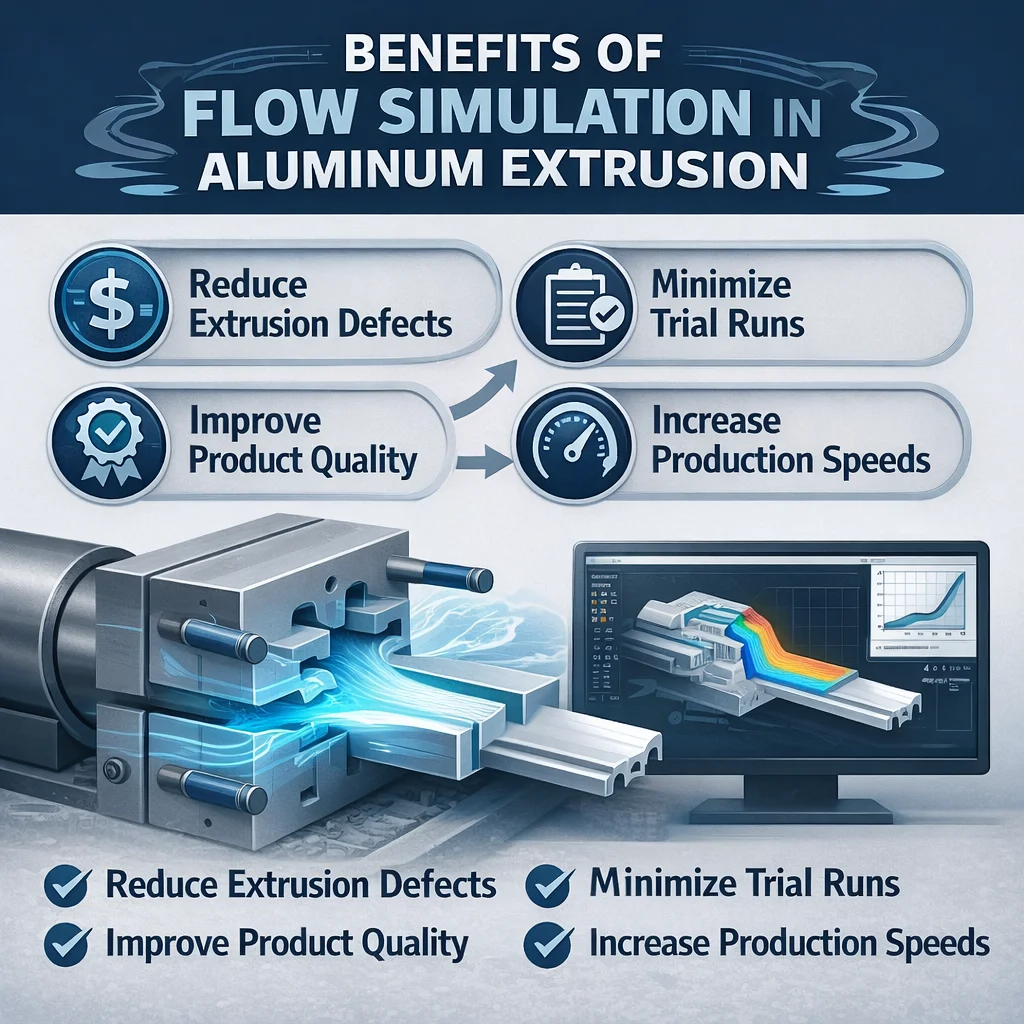
Another major benefit is improved product quality. Uneven metal flow can lead to twisting, bending, surface defects, or dimensional inaccuracies in the extruded profile. Flow simulation allows engineers to adjust bearing lengths, flow channels, and exit velocities to ensure uniform metal distribution throughout the die.
Simulation also contributes to higher extrusion speeds. When metal flow is balanced and controlled, presses can operate at higher ram speeds without introducing defects. This enables extrusion plants to increase production output while maintaining consistent quality.
To further understand how simulation integrates with precision engineering, explore our die engineering and manufacturing services in the UAE
In the UAE’s growing manufacturing sector, where aluminum extrusion supports industries such as construction, infrastructure, automotive components, and solar energy systems, reliable die performance is essential.
Beyond operational improvements, flow simulation also enhances collaboration between engineering teams and extrusion operators. By visualizing metal behavior during the extrusion process, engineers can better communicate design strategies and ensure that the final die performs as intended.
As the aluminum extrusion industry continues to evolve, simulation technology will play an increasingly important role in optimizing productivity and reducing risk.
Contact us today to optimize your extrusion processes with advanced flow simulation and precision die engineering solutions.